The inverse of noise
Noise-cancelling headphones don't block anything. They listen first, then answer. Most brand problems want the same treatment.
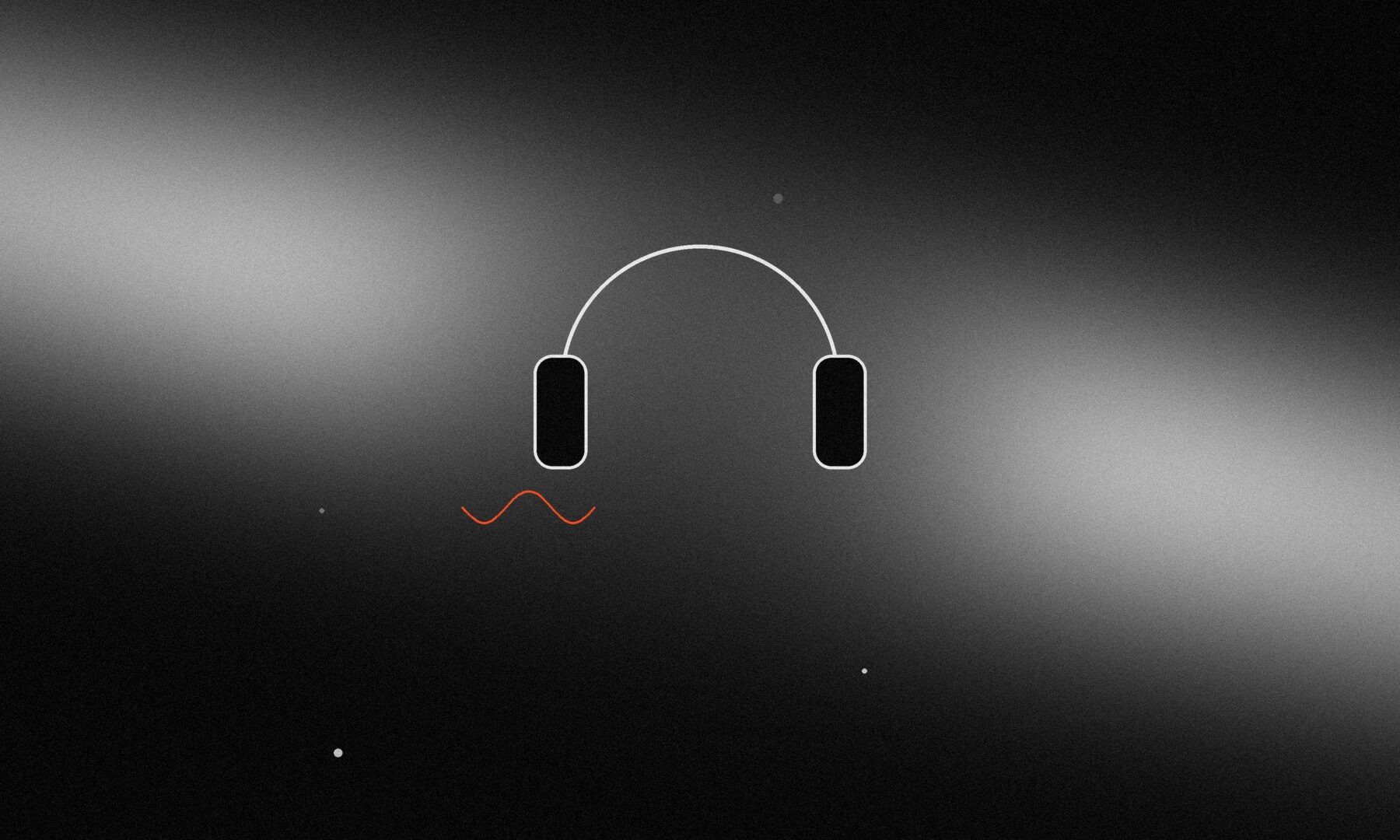
One of us pulled off a pair of noise-cancelling headphones in the middle of the afternoon and said, mostly to the room, “you know these don’t actually block anything, right?” Which sounds like a riddle but is just engineering. The headphones don’t build a wall against sound. A tiny microphone listens to the noise coming in, the electronics generate that noise’s exact inverse, and both waves play at once. Peak meets trough. The sum is silence.
That reframe has been rattling around the studio ever since, because it puts physics under something we’ve believed for years without having the vocabulary for it: most problems don’t yield to force. They yield to the correct inverse.
Force is always the intuitive move. The room is chaotic, so you push harder. The audience is distracted, so you talk louder. The message is confusing, so you explain more. And every one of those responses adds energy to a system that’s already saturated with it, which is why they so rarely work. Chaos doesn’t respond to effort; it responds to structure. Distraction doesn’t respond to volume; it responds to focus. Confusion doesn’t respond to more explanation; it responds to clarity, which is a different substance entirely and usually involves fewer words, not more.
The hard part is precision. Cheap earbuds hiss because their inverse is sloppy, a half-beat late, slightly off in amplitude. Bad anti-noise is just more noise. You have to read the incoming wave accurately before you can cancel it, and this is where most fixes fail. Not because the instinct to simplify was wrong, but because nobody sat still long enough to measure what they were simplifying.
The razor has a stopping point
There’s a seven-hundred-year-old quality check for this. William of Ockham, a fourteenth-century Franciscan friar, gets credited with the razor that carries his name, and the razor gets mangled in retellings into “the simplest answer is the right one.” That’s not what it says. The actual principle is closer to this: don’t multiply entities beyond necessity. Beyond necessity. Those two words are doing all the work. The razor isn’t a license to shave everything off. It’s a blade with a stopping point, and the stopping point is truth. Cut until removing one more thing would make the explanation false. Then put the blade down.
Simple enough to remove the noise. Not so simple you lose the signal. That’s the whole discipline.
The brand version
Now watch a brand drown in its own complexity, because the pattern is nearly universal past a certain age. The navigation has grown to forty items because every department got a seat. There are four sub-brands nobody can explain the boundaries between. The tagline went through eleven stakeholders and now describes nothing, offensively to no one. The messaging deck is sixty slides, and the people who work there quietly maintain their own three-sentence version of what the company does, because the official version is unusable in an actual conversation.
The instinct, at this point, is force. A louder campaign. A bigger media budget. A brighter design system laid over the same tangled architecture, which is the branding equivalent of turning up music to cover a fire alarm. We’ve watched companies spend serious money trying to out-shout their own noise, and the noise always wins, because it’s coming from inside the building and the budget is not.
The inverse move starts with the microphone, not the speaker. What kind of noise is this, specifically? Structural noise, where the offering itself is tangled and no message can survive contact with it? Vocabulary noise, where the thing is sound but described six different ways by six different teams? Historical noise, layers of old positioning nobody ever removed because removal never made anyone’s quarterly goals? Each has a different inverse, and applying the wrong one is how you get the hiss: the beautiful rebrand of a confusing business, the simplified nav over an unsimplified company.
Then, and only then, the razor. Cut the sub-brand that exists for internal political reasons. Cut the second adjective in every sentence. Keep the complexity that’s real, because some businesses genuinely are complicated and pretending otherwise produces a brand that’s simple and wrong, which is worse than complicated and true. The razor has a stopping point. Respect it.
What stays with us from the headphone thing is the part everyone skips. The cancellation isn’t the impressive bit. The listening is. There’s a microphone inside those earcups sampling the world thousands of times a second, and without it the whole trick collapses into noise of its own. Silence, it turns out, is not the absence of an answer.
It’s the right one.