Why the owl
Barn owls hunt alone. Under the right conditions, they live together anyway. Fourteen years in, that contradiction still explains us better than anything we could have made up.
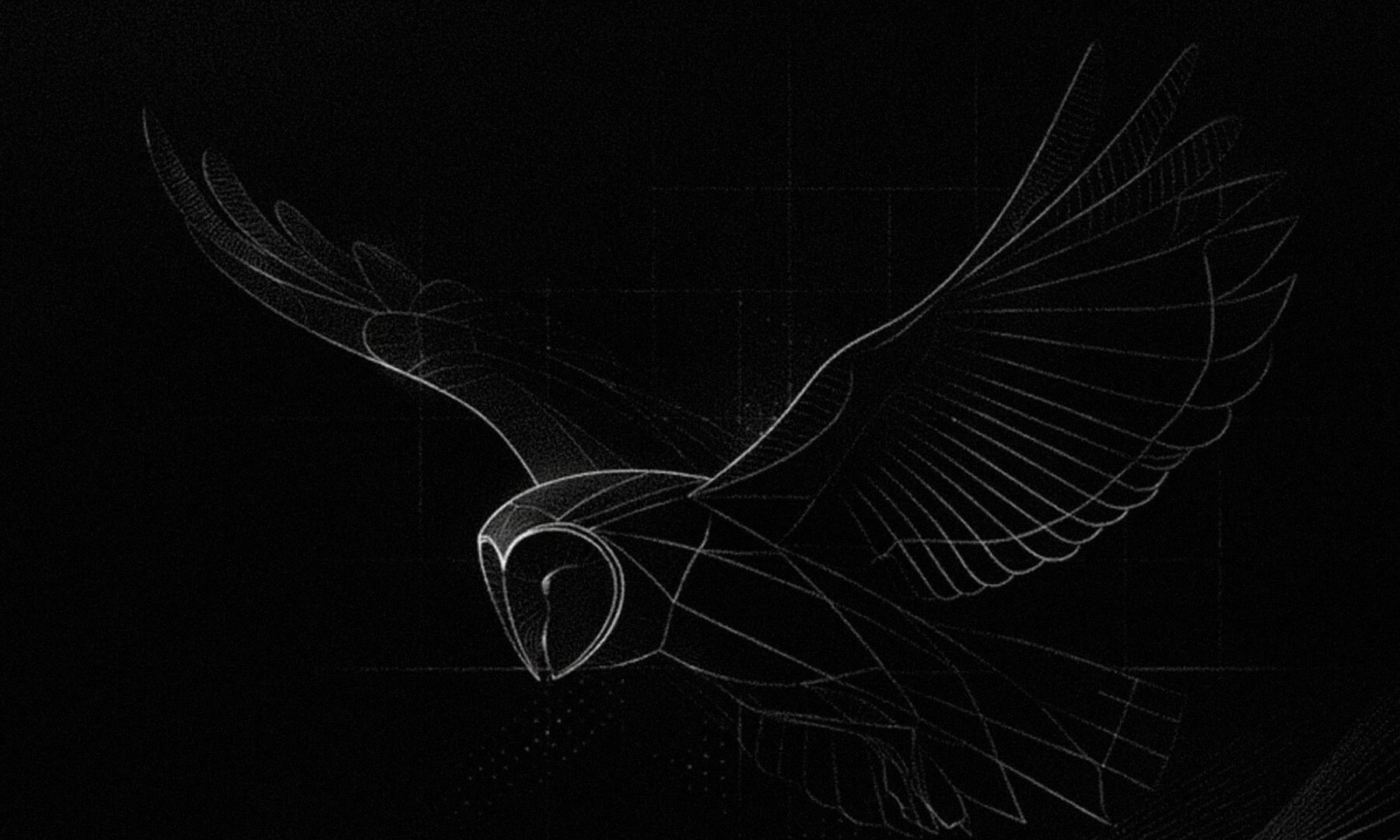
People ask about the owl. Fair question. An agency named Colony, a barn owl on everything, a site in pure black and white. It looks like branding. It started as biology.
The barn owl is a solitary hunter. It flies alone at night, low over open ground, and it is absurdly good at this. That heart-shaped face isn’t decoration; it’s a dish, funneling sound toward ears set at slightly different heights so the bird can triangulate a rustle in the grass it cannot see. It can hunt in total darkness by hearing alone. Its feathers have soft, fringed edges that break up the air, so it flies in near silence. The mouse never hears it coming.
Nothing about this animal needs a team. It doesn’t hunt in packs or call for backup. It’s a self-contained system, built to operate alone at a very high level, and for most of its life that’s exactly what it does.
That should be the end of the story. A lone specialist, tuned over a few million years, no notes.
Except barn owls do something strange.
The colony
Under the right conditions, they gather. Where nesting sites cluster and the hunting is good, barn owls will roost near one another, sometimes several pairs in the same barn or the same stand of trees. Ornithologists call it colonial nesting, which is a mild way of describing something genuinely odd: a solitary animal choosing an address next to other solitary animals.
This isn’t herd instinct. Starlings flock because their wiring says flock. Bees can’t be anything but a hive; the individual bee barely exists outside it. The barn owl has no such programming. It gathers only when gathering pays, when the math of a particular place tips in favor of proximity. Good territory, enough prey to go around, safe places to raise young. When the conditions hold, the colony holds. When they don’t, it dissolves, and nobody’s identity goes with it.
Here’s the part we can’t get over. Inside the colony, nothing about the individual owl changes. It still hunts alone, still flies silent, still runs its own territory of attention, still comes home with what it caught. The colony doesn’t blur the owls into a flock or average them into something tamer. The individuals stay exactly who they are. The outcomes just get better.
No instinct made that happen. Something closer to a decision did.
The point
Everyone at Colony could go solo. Most of us have. Designers who ran their own books for years, developers who were the entire engineering department, strategists and producers who freelanced long enough to know precisely what their time is worth. Nobody’s here because they couldn’t make it alone. That’s not a recruiting line; it’s the founding condition. This company only makes sense as a gathering of people who had other options and weighed them.
Which is why the owl fit before we fully understood why it fit. We didn’t want a hive, where the individual dissolves into the org chart and the work comes out smelling like committee. Nor a machine, where people are components and components are replaceable. What we wanted was the third thing, the rare thing: strong individuals who noticed that proximity was making everyone sharper, and decided to stay.
The agency is the whole idea. A colony of barn owls exists because each bird keeps choosing it, season after season, against a real alternative.
Alignment that can’t be un-chosen isn’t alignment; it’s captivity with better lighting.
Ours gets re-decided constantly, every time someone who could leave doesn’t. That keeps it honest in a way no mission statement ever could.
Clients feel the difference even when they can’t name it. When we embed with a team, they don’t get a process that flattens their problem into whatever shape our machine prefers. They get individual hunters, each one dangerous on their own, pointed at the same thing on purpose. The alignment is real because it was optional.
Fourteen years in, we’ve watched the metaphor get tested. People have left to go hunt alone again, and that’s not a failure of the colony; it’s proof the door works. Others have been here for most of those years, not out of momentum but because the conditions keep being right. The colony holds because it keeps deserving to.
There’s a picture we come back to. A barn at dusk, somewhere with open ground around it. One by one the owls drop out of the loft and disappear into the dark, each on its own line, each after its own quarry, no formation, no signal, nothing shared but the roost behind them. By morning they’re back under the same roof.
Solitary hunters. Same barn. Every night, the choice gets made again.
That’s why the owl.